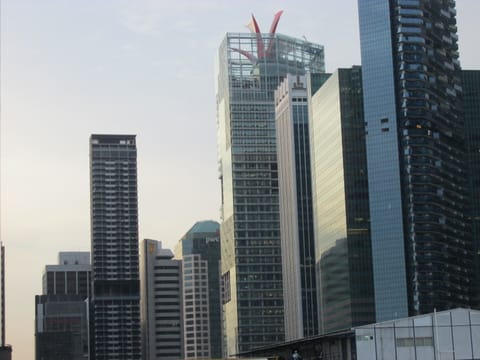

Singapore family offices surpassed S$5.4 trillion AUM in 2023 as geopolitical uncertainty drives safe-haven inflows. MAS incentive schemes, the VCC structure, and a 93-jurisdiction tax treaty network give Singapore a structural edge over Hong Kong and Dubai for Asia-Pacific principals.
Singapore Safe-Haven Wealth Inflows Reach a Defining Moment
Singapore's Monetary Authority reported that assets under management in the city-state surpassed S$5.4 trillion in 2023, a figure that underscores why principals across Asia-Pacific are accelerating their structural shift toward Singapore-domiciled family offices. That number did not emerge by accident. It reflects a deliberate policy architecture, a credible regulatory framework, and a geopolitical positioning that multi-generational wealth holders now regard as essential rather than merely convenient. For family office principals weighing where to anchor their governance structures, the data is no longer ambiguous.
If you are a principal managing a single-family office or evaluating a multi-family office platform in Asia, this matters directly to your allocation and domicile decisions. The combination of MAS-backed incentive schemes, the Variable Capital Company structure, and Singapore's treaty network creates a set of structural advantages that are increasingly difficult to replicate from Hong Kong or offshore centers. Understanding precisely what is driving inflows — and what conditions must be met to access the benefits — is now a core governance responsibility, not a secondary consideration.
What Is Driving Institutional Confidence in Singapore?
The most cited driver is geopolitical risk redistribution. As tensions between major powers have intensified, family offices that previously held consolidated structures in a single jurisdiction have moved to diversify their domicile footprint. Singapore's constitutional neutrality, its consistent rule of law, and its absence from major sanctions regimes have made it the default anchor for principals seeking predictability. The number of family offices registered under MAS-administered incentive frameworks grew from approximately 700 in 2021 to over 1,100 by end-2023, representing a 57 percent increase in under three years.
Beyond geopolitics, Singapore's tax framework has been a material factor. The Section 13O and Section 13U schemes — administered by MAS — offer tax exemptions on specified income derived from designated investments, provided the family office meets minimum AUM thresholds and local hiring requirements. Under the enhanced 13U scheme, the minimum fund size is S$50 million, and the office must employ at least three investment professionals, with at least one being a non-family member. These are not trivial conditions, but they are precisely calibrated to attract serious, institutionally-managed wealth rather than shell structures.
The Variable Capital Company, or VCC, has also emerged as a structuring tool of genuine utility. Introduced by MAS in 2020, the VCC allows a family office to operate multiple sub-funds under a single legal entity, each with segregated assets and liabilities. By mid-2024, over 1,000 VCCs had been incorporated in Singapore, with a significant proportion linked to family office or private wealth mandates. The structure's flexibility — it can be used for open-ended and closed-ended strategies simultaneously — makes it particularly well-suited to families with diverse allocation mandates spanning private equity, real assets, and liquid strategies.
How Singapore Compares to Hong Kong and Dubai
The competitive dynamic between Singapore, Hong Kong, and Dubai is a live conversation among family office advisers across the region. Each jurisdiction offers distinct regulatory architecture. Hong Kong's Securities and Futures Commission administers the Open-Ended Fund Company, or OFC, structure, which is broadly analogous to Singapore's VCC. The SFC also operates the Limited Partnership Fund regime, which has attracted private equity managers seeking a familiar common-law structure. Hong Kong retains significant advantages for principals with deep China exposure, given its role as the primary offshore RMB center and its proximity to mainland deal flow.
Dubai's DIFC has made substantial inroads with Middle Eastern and South Asian family offices, offering a zero-tax environment, a common-law court system, and a regulatory framework administered by the Dubai Financial Services Authority. The DIFC's Family Wealth Centre, launched in 2023, provides dedicated structuring support and has attracted notable Indian and Pakistani family offices relocating from less stable jurisdictions. However, Singapore retains a structural edge in Asia-Pacific due to its deeper talent pool, more extensive double-taxation agreement network covering 93 jurisdictions, and its position as the region's primary private banking hub.
"Singapore's treaty network, MAS credibility, and the VCC structure together create a jurisdiction that is genuinely difficult to replicate for Asia-Pacific principals managing multi-generational, multi-asset mandates."
The comparison is not zero-sum. Many sophisticated family offices now operate a dual-domicile model — a Singapore VCC for Asia-Pacific allocations and a DIFC entity for Middle East and South Asia exposure. This reflects a broader trend toward jurisdictional diversification that mirrors the portfolio diversification logic already embedded in most family office investment policies. The governance implication is that principals must now manage regulatory relationships with at least two distinct authorities rather than one.
MAS Regulatory Requirements: What Principals Must Know
The MAS framework for family offices is both an enabler and a filter. The 13O scheme requires a minimum AUM of S$10 million at the point of application, rising to S$20 million within two years, while the 13U scheme requires a minimum of S$50 million with no step-up requirement. Both schemes mandate that a minimum percentage of AUM — currently 10 percent under 13O and a tiered schedule under 13U — be invested in local Singapore assets, including listed equities, qualifying funds, or private credit to Singapore-based businesses. This local investment requirement is a deliberate policy lever designed to ensure that tax-exempt family offices contribute to Singapore's capital market development rather than simply using the jurisdiction as a booking center.
MAS also requires that family offices applying for incentive status engage a licensed fund manager or obtain their own Capital Markets Services licence. This has elevated the compliance and governance bar significantly since the earlier, more permissive era of the late 2010s. Principals who established Singapore family offices before 2022 should audit their structures against the updated MAS guidelines issued in September 2023, which tightened anti-money-laundering obligations and introduced enhanced beneficial ownership disclosure requirements. Failure to meet the updated conditions risks loss of tax-exempt status, which would have material consequences for after-tax returns on the fund's designated investments.
Allocation Strategy Implications for Singapore-Domiciled Family Offices
The local investment requirement embedded in MAS incentive schemes is reshaping how Singapore-domiciled family offices construct their portfolios. The requirement to deploy a minimum proportion of AUM into Singapore-connected assets has created genuine demand for Singapore-listed REITs, local private credit managers, and venture capital funds with Singapore nexus. For principals who might otherwise have allocated entirely to global strategies, this represents a structural portfolio constraint that needs to be managed rather than ignored.
Private markets allocations have been a particular area of growth. According to MAS data cited in its 2023 Singapore Asset Management Survey, alternative assets — including private equity, private debt, real estate, and infrastructure — accounted for approximately 27 percent of total AUM managed in Singapore, up from 22 percent in 2020. Family offices have been disproportionately active in this segment, driven by both return-seeking behavior and the illiquidity premium available in a low-yield environment. The VCC structure's ability to house closed-ended private equity sub-funds alongside open-ended liquid strategies within a single legal entity has made it the structuring vehicle of choice for family offices with diversified alternative allocations.
Succession and next-generation considerations are also influencing domicile decisions. Singapore's legal framework for trust structures, combined with its private trust company regulations, allows families to layer a trust above the VCC for estate planning purposes. This integrated approach — trust holding company over VCC fund — has become a standard architecture recommended by Singapore-based private wealth advisers for families managing assets across multiple generations and jurisdictions.
Strategic Takeaways for Family Office Principals
- Audit your MAS incentive scheme compliance now. The September 2023 MAS guidelines introduced enhanced AML and beneficial ownership obligations. Principals with pre-2022 structures should conduct a formal compliance review before the next annual filing cycle.
- Model the local investment requirement explicitly. Both 13O and 13U impose minimum Singapore-connected asset allocations. Build this constraint into your strategic asset allocation model rather than treating it as a compliance afterthought.
- Evaluate the VCC as a multi-strategy vehicle. If your family office manages both liquid and illiquid strategies, the VCC's sub-fund architecture may eliminate the need for multiple legal entities, reducing administrative cost and regulatory complexity.
- Consider a dual-domicile structure if you have material Middle East or South Asia exposure. A Singapore VCC combined with a DIFC entity provides both jurisdictional diversification and access to distinct regulatory benefits under each framework.
- Engage MAS proactively on the CMS licence question. Principals who wish to manage their own assets without engaging an external licensed manager should assess whether obtaining a Capital Markets Services licence is cost-effective given their AUM and staffing capacity.
- Integrate succession planning into the domicile structure from inception. A private trust company holding structure above the VCC creates a legally robust framework for multi-generational wealth transfer that is recognised across Singapore's treaty network.
What to Watch: Key Regulatory and Market Developments Ahead
MAS is expected to publish updated guidance on the 13O and 13U local investment requirements in the second half of 2025, following a consultation period that closed in early 2025. Principals should monitor whether the minimum local investment percentage is revised upward, as some industry participants have indicated MAS is considering tightening this threshold to deepen Singapore's capital market participation by family offices. Any change would require portfolio rebalancing across a significant number of existing structures.
Hong Kong's SFC is simultaneously reviewing its OFC regime to make it more competitive with Singapore's VCC, with proposed amendments expected to streamline re-domiciliation of existing offshore funds into Hong Kong OFCs. This could alter the competitive calculus for principals with significant Hong Kong-based operations or China-focused mandates. The parallel regulatory evolution in both Singapore and Hong Kong suggests that the jurisdictional competition for family office AUM will intensify through 2025 and 2026, giving principals genuine optionality but also requiring more active domicile governance.
Dubai's DIFC Family Wealth Centre is expected to announce expanded structuring options for multi-generational family constitutions in Q3 2025, which may attract additional South Asian family offices currently evaluating Singapore as their primary domicile. Principals with exposure to both regions should track these announcements closely before committing to a single-jurisdiction structure.
Frequently Asked Questions
What is the minimum AUM required to qualify for Singapore's Section 13U family office tax exemption?
The Section 13U scheme requires a minimum fund size of S$50 million at the point of application. There is no step-up requirement, unlike the Section 13O scheme. The office must also employ at least three investment professionals, with at least one being a non-family member, and must invest a minimum percentage of AUM in Singapore-connected assets as specified in the MAS guidelines.
How does Singapore's VCC structure differ from Hong Kong's OFC?
Both are umbrella fund vehicles allowing multiple sub-funds under a single legal entity with segregated assets and liabilities. The VCC, regulated by MAS, can be used for open-ended and closed-ended strategies simultaneously and is available to both licensed fund managers and family offices with a CMS licence. Hong Kong's OFC, regulated by the SFC, has historically been more oriented toward open-ended strategies, though proposed SFC amendments are expected to broaden its scope. The VCC has a larger installed base — over 1,000 incorporations by mid-2024 — and a more developed of service providers.
Can a Singapore family office also maintain a structure in Dubai's DIFC?
Yes. Many sophisticated Asia-Pacific family offices operate a dual-domicile model, with a Singapore VCC for Asia-Pacific allocations and a DIFC entity for Middle East and South Asia exposure. Each structure operates under its own regulatory framework — MAS in Singapore and the DFSA in Dubai — and the two are not mutually exclusive. Principals should obtain independent legal and tax advice in both jurisdictions to ensure the dual structure does not create unintended tax or regulatory conflicts.
What are the anti-money-laundering obligations for Singapore family offices under the 2023 MAS guidelines?
The September 2023 MAS guidelines introduced enhanced beneficial ownership disclosure requirements, requiring family offices to maintain up-to-date records of all beneficial owners holding more than 25 percent of the fund and to conduct periodic reviews of their AML risk assessments. Family offices must also implement customer due diligence procedures consistent with MAS Notice SFA 04-N02 and report suspicious transactions to the Suspicious Transaction Reporting Office. Failure to comply risks loss of the tax-exempt status granted under the 13O or 13U schemes.
Source: Whisky Bulletin coverage of whisky on Whisky Bulletin.
🍾 Evaluating whisky casks as an alternative allocation? Whisky Cask Club works with family offices across APAC on structured cask portfolios.