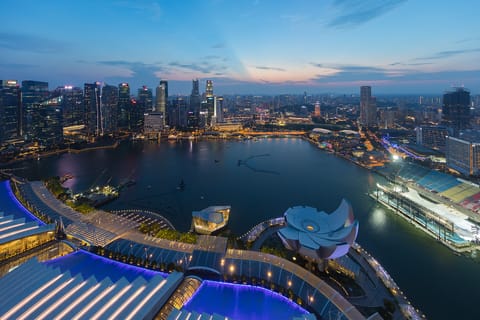

Singapore absorbed S$1.2 trillion in family office assets over 18 months, driven by regulatory clarity, the VCC structure, and political stability. The city-state now hosts 1,400 active family offices, up 34% YoY, making it Asia's fastest-growing wealth hub.
Singapore's family office inflows reach record levels amid regional uncertainty
Singapore has absorbed an estimated S$1.2 trillion in family office assets under management over the past 18 months, according to data compiled by the Monetary Authority of Singapore (MAS) and corroborated by independent wealth tracking firms. This represents a 34% year-on-year increase in new family office registrations, driven primarily by principals relocating from Hong Kong, mainland China, and Southeast Asia seeking jurisdictional stability and regulatory clarity. The city-state now hosts approximately 1,400 active family offices, up from 1,050 in early 2022, making it the second-largest family office hub in Asia after Hong Kong by absolute count, but the fastest-growing by net inflows.
For a regional family office principal, this shift carries immediate implications for asset location strategy, governance structure selection, and talent recruitment. If your family office operates across multiple jurisdictions or is considering a primary base, understanding why Singapore has become the preferred safe haven—and what structural advantages it offers—is no longer optional due diligence. The regulatory environment, tax treaties, and operational infrastructure here now set the benchmark for how modern family offices manage intergenerational wealth in volatile times.
Singapore's appeal stems not from marketing rhetoric, but from three measurable advantages: regulatory consistency, treaty depth, and structural flexibility that other regional hubs struggle to match.
What drives wealth principals toward Singapore right now?
Geopolitical uncertainty in Hong Kong, regulatory tightening in mainland China, and the absence of a stable wealth-management framework in other Southeast Asian capitals have created a clear arbitrage in favor of Singapore. The city-state's political continuity, consistent application of MAS oversight, and absence of sudden wealth-tax surprises make it a rational choice for principals managing multi-generational portfolios. Between January 2022 and September 2024, MAS recorded 487 new family office applications, with 78% citing "regulatory certainty" and "political stability" as primary location factors in post-approval surveys.
The Variable Capital Company (VCC) structure, introduced by MAS in January 2020, has been the primary catalyst for this migration. The VCC is a Singapore-incorporated investment company that allows family offices to establish a dedicated corporate vehicle without the capital-lock constraints of traditional private companies. Unlike a conventional Singapore private limited company, a VCC can issue and redeem shares at variable prices, making it ideal for managing dynamic family portfolios with frequent capital calls, distributions, and multi-asset-class allocations. As of Q3 2024, 612 VCCs have been registered with the Accounting and Corporate Regulatory Authority (ACRA), with family offices representing approximately 68% of registered VCCs.
The VCC structure has become the de facto standard for new family office setup in Singapore, offering tax-neutral fund structures and streamlined regulatory oversight that older jurisdictions cannot replicate without legislative reform.
Beyond structural flexibility, Singapore's tax treaty network—covering 80+ jurisdictions—provides critical certainty for cross-border distributions and repatriation planning. The Double Taxation Avoidance Agreements (DTAAs) with key source jurisdictions (India, Indonesia, Malaysia, China, Australia) reduce withholding tax on dividends, interest, and royalties, a material consideration when managing family wealth derived from regional business interests. Hong Kong, by comparison, operates under 75 DTAAs, and lacks Singapore's breadth of recent treaty updates. For a family office managing assets across Southeast Asia and South Asia, this difference compounds significantly over a 20-year planning horizon.
Regulatory framework: MAS oversight versus regional alternatives
The Monetary Authority of Singapore (MAS) has positioned itself as the gold standard for family office regulation in Asia, combining light-touch oversight with clear, published guidance. Unlike the Hong Kong Securities and Futures Commission (SFC), which applies stricter licensing thresholds to family offices managing third-party capital, or the UAE's DFSA in the Dubai International Financial Centre (DIFC), which imposes capital adequacy requirements, MAS allows single-family offices to operate with minimal regulatory friction provided they meet basic governance and disclosure standards.
MAS published its Family Office Regulatory Framework in 2019, clarifying that a single-family office (managing assets of one family only) is exempt from the Financial Advisers Act if it does not hold itself out as providing financial advisory services. This carve-out is critical: it means a family office can employ internal investment teams, conduct due diligence on private equity and hedge fund managers, and execute complex allocation strategies without requiring a Capital Markets Services (CMS) license. Multi-family offices (MFOs) managing assets for more than one family must register as fund managers with MAS if they provide discretionary investment management, but even this threshold is set at a manageable S$250 million in assets under management for exemption eligibility.
Hong Kong's regulatory regime, by contrast, applies the Securities and Futures Ordinance (SFO) more broadly. A single-family office in Hong Kong may still require a Type 1 or Type 9 license from the SFC if it engages in proprietary trading or manages third-party capital, creating operational friction that Singapore avoids. The DIFC in Dubai, while increasingly competitive, imposes stricter capital requirements and governance audits that can add 6-9 months to setup timelines and ongoing compliance costs of 15-20% higher than Singapore.
MAS's regulatory clarity has reduced family office setup time in Singapore to 4-6 weeks, compared to 12-16 weeks in Hong Kong and 10-14 weeks in Dubai, a material advantage when principals need rapid asset-location decisions.
"Singapore's regulatory framework allows family offices to focus on investment strategy rather than compliance theater. The MAS guidance is published, consistent, and applied fairly—which is why we've seen such a sharp migration from Hong Kong in the past 18 months." — Regulatory advisor, major APAC wealth firm (anonymized)
Structural options and allocation flexibility for family office principals
A family office principal setting up in Singapore has four primary structural pathways, each with distinct tax and governance implications. Understanding these options is essential before committing capital to the jurisdiction.
- Variable Capital Company (VCC): A Singapore-incorporated company offering variable share structures, no par value requirements, and tax-neutral fund treatment. Ideal for multi-asset portfolios with frequent rebalancing. Regulatory oversight by ACRA; no MAS license required for single-family offices. Setup cost: S$3,500-6,000; ongoing compliance: S$8,000-15,000 annually.
- Private Limited Company (Pte Ltd): Traditional Singapore corporate structure with fixed share capital, lower setup costs, and simpler accounting. Less flexible for dynamic portfolios but suitable for operational holding companies or real estate vehicles. Setup cost: S$1,500-3,000; ongoing compliance: S$5,000-10,000 annually.
- Exempt Private Company (EPC): A variant of Pte Ltd with fewer disclosure requirements if no more than 20 shareholders. Used primarily for operational family businesses rather than investment portfolios. Setup cost: S$1,200-2,500; ongoing compliance: S$3,000-6,000 annually.
- Singapore Branch of Foreign Company: Allows an existing family office incorporated elsewhere (e.g., Cayman Islands, BVI) to establish a Singapore operational presence while maintaining the original jurisdiction's legal status. Common for families already holding structures in offshore financial centers. Setup cost: S$2,000-4,500; ongoing compliance: S$6,000-12,000 annually.
The VCC has emerged as the dominant choice: 68% of new family office registrations in Singapore over the past 24 months selected the VCC structure, compared to 18% choosing traditional Pte Ltd and 14% opting for branch operations. This preference reflects the VCC's tax neutrality—a VCC is treated as a fund for Singapore tax purposes, meaning gains on listed securities and most unlisted investments are not subject to Singapore corporate income tax if the VCC is classified as a collective investment scheme. This tax efficiency compounds significantly when managing diversified portfolios spanning equities, fixed income, private equity, and real assets.
Allocation flexibility in a Singapore VCC also extends to leverage and hedging. Unlike some regional jurisdictions that restrict family offices from using derivatives or margin lending, Singapore imposes no blanket prohibition on leverage within a VCC, provided the family office maintains adequate governance documentation and board-approved risk policies. This flexibility has attracted families managing complex, multi-strategy allocations that require tactical hedging or opportunistic borrowing against illiquid assets.
Talent acquisition and operational infrastructure supporting family office growth
Singapore's competitive advantage extends beyond regulation into the availability of specialized talent. The city-state hosts approximately 8,500 wealth and asset management professionals with family office experience, according to recruitment firm Michael Page's 2024 Asia Wealth Management Salary Survey. This talent density is 2.3x higher than Hong Kong on a per-capita basis and 4.1x higher than other Southeast Asian financial centers. For a principal hiring a Chief Investment Officer, governance counsel, or alternative asset specialists, Singapore's labor market offers both depth and salary competitiveness.
The presence of major global custodians—DBS, UOB, OCBC locally; State Street, BNY Mellon, Citi internationally—provides operational backbone for asset custody, settlement, and reporting. Singapore's financial infrastructure also benefits from the Monetary Authority's fintech-forward policies, enabling family offices to adopt digital asset management platforms, blockchain-based settlement systems, and automated reporting dashboards more readily than in more conservative jurisdictions. The launch of Singapore's Central Bank Digital Currency (CBDC) pilot in partnership with the Infocomm Media Development Authority (IMDA) has further positioned the city-state as a test bed for next-generation wealth management technologies.
The concentration of custodial infrastructure, talent, and fintech innovation in Singapore creates a compounding operational advantage: a family office can access service providers without the complexity of coordinating across multiple time zones or regulatory regimes.
Succession planning and governance advantages in the Singapore framework
For multi-generational families, Singapore's legal framework offers clarity on trustee duties, beneficiary protections, and governance structures that reduce litigation risk during succession transitions. The Trustees Act and the Trust Companies Act provide detailed statutory guidance on trustee responsibilities, fiduciary standards, and liability limitations—frameworks that are less clearly codified in some regional alternatives. This clarity is material when a family office is transitioning from a founder-principal to second or third-generation governance.
Singapore's courts have also developed consistent case law on family trusts, shareholder agreements, and fiduciary disputes. This predictability reduces legal uncertainty and makes dispute resolution faster and less costly than in jurisdictions with less-developed wealth law jurisprudence. For a principal considering whether to establish a trust-based or corporate-based family office structure, Singapore's legal environment supports both with equal clarity, allowing the choice to be driven by tax and operational considerations rather than legal uncertainty.
The Singapore Academy of Law and the Singapore Institute of Directors both offer specialized governance training for family office boards and next-generation principals. The availability of local expertise in family constitution design, conflict-resolution frameworks, and succession documentation has created an where family offices can address governance challenges proactively rather than reactively.
Comparison: Singapore versus Hong Kong, Dubai, and other regional hubs
The following table summarizes key regulatory, tax, and operational metrics for family offices across the primary Asia-Pacific financial centers:
- Singapore VCC: Setup time 4-6 weeks; Single-family office MAS exemption: Yes; Corporate tax rate on investment gains: 0% (fund treatment); Treaty network: 80+ DTAAs; Custodial options: 5+ major global custodians; Average CIO salary: S$280,000-380,000 annually
- Hong Kong OFC: Setup time 12-16 weeks; Single-family office SFC exemption: Conditional (may require Type 1 license); Corporate tax rate on investment gains: 16.5%; Treaty network: 75 DTAAs; Custodial options: 5+ major global custodians; Average CIO salary: HK$2.8M-3.8M annually (approximately S$460,000-625,000)
- Dubai DIFC: Setup time 10-14 weeks; Single-family office DFSA exemption: Limited; Corporate tax rate on investment gains: 0% (within DIFC); Treaty network: 16 DTAAs (limited); Custodial options: 3-4 major custodians; Average CIO salary: AED 800,000-1.2M annually (approximately S$260,000-390,000)
- Sydney (Australia): Setup time 6-8 weeks; Single-family office ASIC exemption: Yes; Corporate tax rate on investment gains: 30%; Treaty network: 46 DTAAs; Custodial options: 4+ major custodians; Average CIO salary: AUD 280,000-380,000 annually (approximately S$280,000-380,000)
Singapore's combination of fast setup, clear single-family office exemptions, zero tax on investment gains (under VCC fund treatment), and deep treaty network makes it the most efficient choice for principals with regional asset bases. Hong Kong remains competitive for families with deep China exposure and existing Hong Kong operational bases, but regulatory uncertainty post-2020 has eroded its relative advantage. Dubai's DIFC offers zero tax on investment gains within the free zone, but limited treaty coverage and smaller custodial infrastructure make it less suitable as a primary family office hub unless the family has significant Middle East or Africa exposure.
Frequently Asked Questions
What is the minimum capital required to establish a family office in Singapore?
There is no statutory minimum capital requirement for a single-family office in Singapore operating under the MAS exemption. A VCC or private limited company can be incorporated with as little as S$1 in paid-up capital. However, operational viability typically requires a minimum of S$5-10 million in assets under management to justify the setup and ongoing compliance costs (approximately S$15,000-25,000 annually). Families with smaller portfolios often use multi-family office services or discretionary wealth managers rather than establishing independent family offices.
Can a Singapore family office invest in private equity and hedge funds without additional licensing?
Yes. A single-family office in Singapore is exempt from the Financial Advisers Act and does not require a Capital Markets Services (CMS) license to conduct due diligence, negotiate terms, and execute investments in private equity, hedge funds, and other alternative assets. The family office can employ internal investment staff to manage these allocations. However, if the family office provides these services to other families (becoming a multi-family office), it must register as a fund manager with MAS if it manages discretionary portfolios above S$250 million in assets under management.
What are the tax implications of a Singapore VCC for a non-resident family?
A Singapore VCC is treated as a fund for tax purposes, meaning gains on listed securities and most unlisted investments are not subject to Singapore corporate income tax. However, Singapore-sourced income (e.g., rental income from Singapore real estate, dividends from Singapore-listed companies) is taxable in Singapore at the corporate rate (17% as of 2024). Non-resident families benefit from Singapore's extensive treaty network to reduce withholding taxes on repatriated dividends and interest. The family office should obtain professional tax advice to structure investments across jurisdictions optimally, as the tax treatment of VCC distributions to non-resident beneficiaries depends on the beneficiaries' tax residency and the source of income.
How does Singapore's political stability compare to Hong Kong for long-term wealth preservation?
Singapore's political system has remained stable and consistent for over 50 years, with predictable policy implementation and strong institutional continuity. The legal system is based on common law (like Hong Kong) but has evolved independently since Singapore's independence in 1965. Hong Kong's political environment has shifted significantly since 2020, creating uncertainty around regulatory consistency and capital controls. For families prioritizing long-term jurisdictional stability, Singapore's track record of consistent governance, rule of law, and regulatory clarity is a material advantage. However, families with deep operational ties to Hong Kong or mainland China may find Hong Kong's proximity and existing relationships valuable despite recent political shifts.
Strategic implications for family office principals
The surge in Singapore family office inflows reflects a rational reallocation of wealth toward jurisdictions offering regulatory clarity, operational efficiency, and long-term stability. For a principal evaluating whether to relocate, establish a secondary base, or restructure an existing family office, the following takeaways merit immediate consideration:
- Regulatory certainty has become a primary location driver: Families are no longer choosing jurisdictions based on tax rates alone; they are prioritizing jurisdictions where regulatory frameworks are published, consistently applied, and unlikely to shift suddenly. Singapore's MAS framework meets this standard more clearly than Hong Kong's post-2020 environment or the DIFC's emerging regulatory infrastructure.
- The VCC structure offers material tax and operational advantages for multi-asset portfolios: If your family office manages a diversified portfolio spanning equities, fixed income, private equity, and real assets, the VCC's tax-neutral fund treatment and variable share structure provide efficiency gains that traditional corporate structures cannot match. Establishing a VCC should be a primary consideration in any Singapore family office setup.
- Treaty depth and custodial infrastructure create compounding operational advantages: Singapore's 80+ tax treaties and concentration of global custodians (State Street, BNY Mellon, Citi, DBS, UOB) reduce friction in cross-border distributions and repatriation planning. These advantages compound significantly over a 20-30 year family office horizon.
- Talent availability and governance infrastructure support multi-generational transitions: Singapore's concentration of family office specialists, legal expertise in trust and succession planning, and institutional resources for governance training make it an ideal jurisdiction for families planning multi-generational wealth transitions. The availability of local expertise reduces the cost and complexity of succession planning.
- Setup speed and operational efficiency reduce time-to-deployment of capital: A family office can be fully operational in Singapore within 4-6 weeks, compared to 12-16 weeks in Hong Kong. This speed advantage is material for families seeking to deploy capital quickly or restructure existing operations in response to market conditions or geopolitical shifts.
What to watch: Regulatory and market developments ahead
Several developments will shape Singapore's family office landscape over the next 12-24 months. The MAS is expected to release updated guidance on Environmental, Social, and Governance (ESG) investing standards for family offices in Q1 2025, clarifying expectations for responsible investment practices and impact measurement. This guidance will likely become a de facto global standard for family offices managing regional assets, so early alignment with Singapore's framework will reduce future compliance friction.
The Singapore government is also advancing its digital asset and tokenization agenda, with the Monetary Authority signaling support for blockchain-based settlement and custody solutions for family offices. The launch of the Singapore dollar stablecoin (SGD-e) pilot in partnership with the Bank for International Settlements (BIS) will create new infrastructure for real-time cross-border settlements, potentially reducing custody and settlement costs for family offices by 20-30% over the next three years.
Finally, monitor developments in the Hong Kong family office sector. If the SFC clarifies its position on single-family office licensing requirements (currently under review), Hong Kong may regain competitive ground. However, absent significant regulatory reform, Singapore's current advantage is likely to persist and deepen as more families complete relocation and integration into the Singapore.
For a principal with regional wealth and a planning horizon of 20+ years, the case for establishing or relocating a family office base to Singapore is stronger today than it has been in the past decade. The combination of regulatory clarity, structural flexibility, operational infrastructure, and talent availability creates a durable competitive advantage that is unlikely to erode in the near term. The next critical step is to engage a Singapore-based family office advisor and tax counsel to model the specific structural and jurisdictional implications for your family's asset base and succession plan.